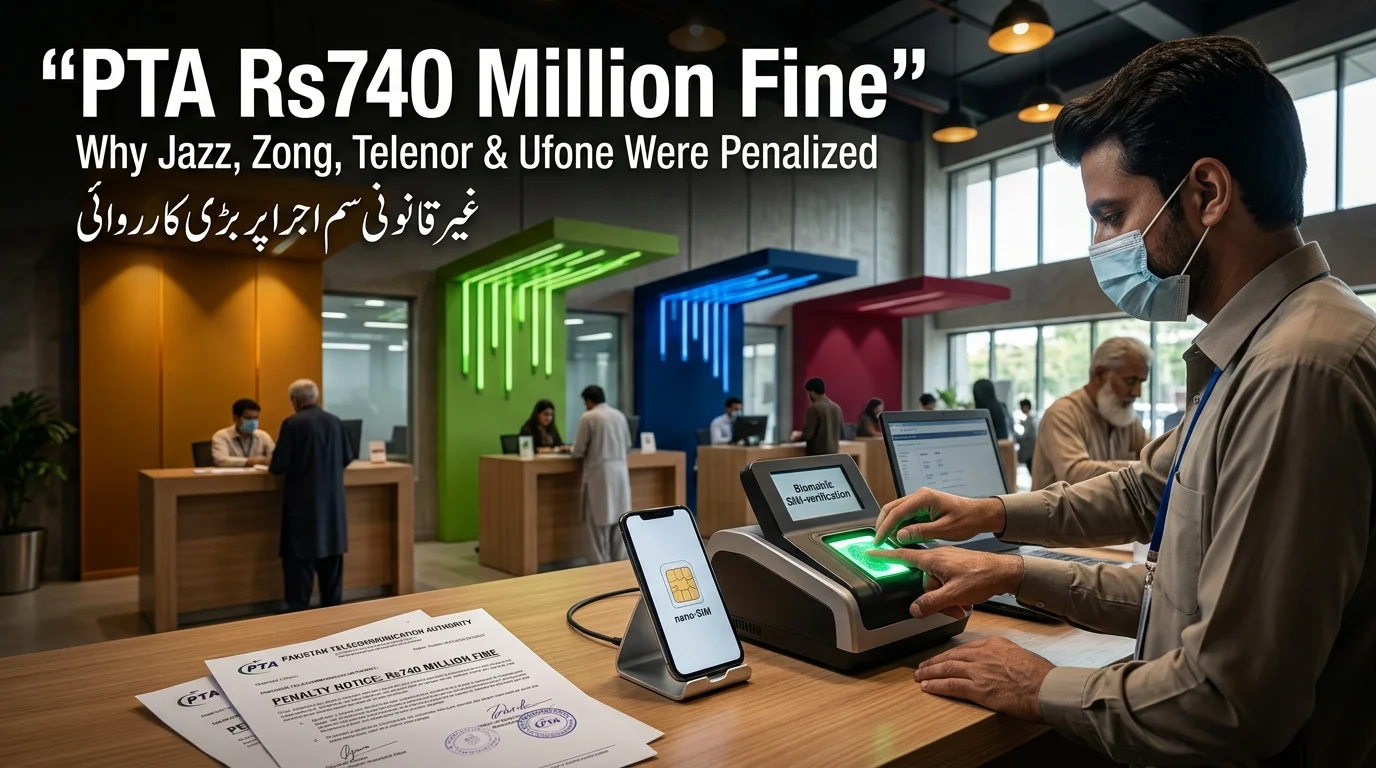
PTA Rs740 Million Fine: Why Jazz, Zong, Telenor & Ufone Were Penalized
The Pakistan Telecommunication Authority (PTA) has imposed fines totaling approximately Rs740 million on four major mobile network operators, Jazz, Zong, Telenor, and Ufone, for illegal SIM issuance. The operators faced accusations of activating SIMs without subscriber consent, failing biometric verification, misusing CNIC data, and losing control over their franchise networks. The enforcement orders were issued under the Pakistan Telecommunication (Re-organization) Act of 1996.
پاکستان ٹیلی کمیونیکیشن اتھارٹی (پی ٹی اے) نے غیر قانونی سم جاری کرنے پر چار بڑے موبائل نیٹ ورک آپریٹرز جاز، زونگ، ٹیلی نار اور یوفون پر مجموعی طور پر تقریباً 740 ملین روپے کے جرمانے عائد کیے ہیں۔ آپریٹرز کو سبسکرائبرز کی رضامندی کے بغیر سمز کو فعال کرنے، بائیو میٹرک تصدیق میں ناکامی، CNIC ڈیٹا کا غلط استعمال، اور اپنے فرنچائز نیٹ ورکس پر کنٹرول کھونے کے الزامات کا سامنا کرنا پڑا۔ نفاذ کے احکامات پاکستان ٹیلی کمیونیکیشن (ری آرگنائزیشن) ایکٹ 1996 کے تحت جاری کیے گئے تھے۔
Quick Facts
| Regulator | Pakistan Telecommunication Authority (PTA) |
| Operators fined | Jazz, Zong (China Mobile Pakistan), Telenor Pakistan, Ufone |
| Reported total penalty | Rs740 million |
| Core issue | Illegal/unauthorized SIM issuance |
| Key controls involved | Biometric verification (BVS), Live Finger Detection (LFD), geofencing |
| Regulatory basis | Section 23, Pakistan Telecommunication (Re-organization) Act, 1996, and Subscribers Antecedents Verification Regulations |
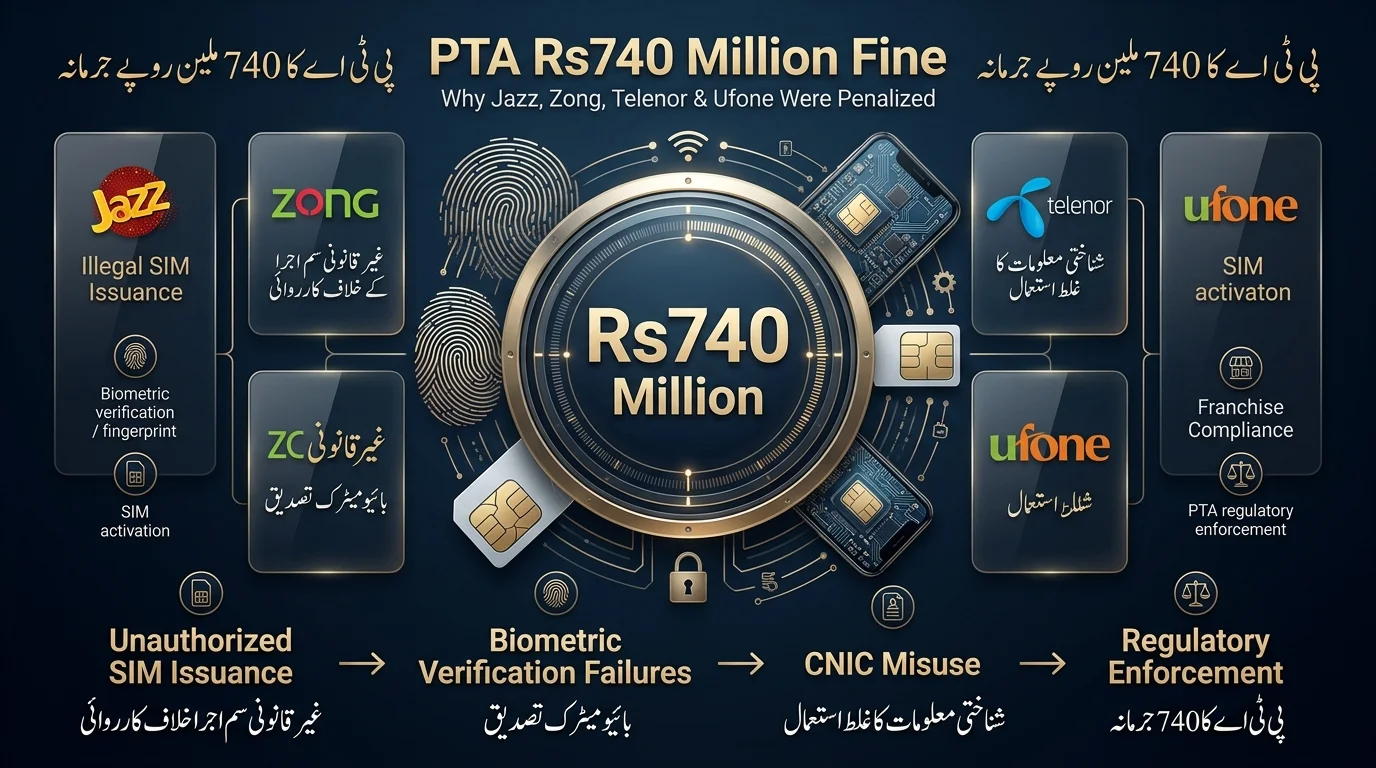
PTA Rs740 Million Fine: Complete Breakdown
How much was each telecom operator fined?
| Operator | Reported fine | Main issue | Regulatory concern |
| Jazz | Rs116.7 million | Unauthorized SIM issuance and weak monitoring | Verification/compliance |
| Zong (China Mobile Pakistan) | Rs155.6 million | SIM issuance violations | Franchise/verification |
| Telenor | Rs116.7 million | Unauthorized activation against a subscriber’s CNIC | Subscriber verification |
| Ufone | Rs116.7 million + Rs77.8 million + Rs38.9 million (over Rs233.4 million total) | Multiple violations, large-scale illegal issuance | SIM/franchise compliance |
Why does the total need clarification?
News reports frequently cite a total penalty figure of around Rs740 million for telecom operators. However, when adding up the individually reported penalties (Rs155.6 million for Zong, Rs116.7 million for Jazz, Rs116.7 million for Telenor, and Rs233.4 million for Ufone), the total is approximately Rs622.4 million. This discrepancy is likely due to incomplete public breakdowns rather than mere reporting errors. Ufone’s penalties alone involve multiple cases, and there may be additional penalties not specified in public records. Readers should consider the Rs740 million as the overall figure reported by the regulator, while the individual amounts represent confirmed enforcement figures.
Why Did PTA Fine Jazz, Zong, Telenor and Ufone?
The text addresses issues related to the illegal issuance and activation of SIM cards in Pakistan, highlighting several key points:
- Unauthorized Activation: Operators or their authorized sellers activated SIMs without the legitimate subscriber’s consent, violating Pakistan’s SIM verification requirements.
- Identity Misuse: Investigators found cases where individuals activated SIMs under other people’s CNICs without their knowledge or consent. Authorities often discovered these cases when the affected individuals raised complaints or made inquiries.
- Biometric Verification Failures: Some sellers bypassed or improperly completed the required biometric fingerprint verification, weakening an important safeguard against identity misuse.
- Franchise and Retailer Violations: Franchise and retail outlets played a significant role in unauthorized SIM issuance. These violations also placed responsibility on mobile operators for the actions of their authorized sellers.
- Registration vs. Activation: Legitimate SIM registration requires the subscriber’s CNIC and biometric verification before activation. Unauthorized activation occurs when someone activates a SIM without following the required verification procedures or without the subscriber’s consent.
This summary encapsulates the main points regarding illegal SIM issuance and the regulatory shortcomings in Pakistan.
How Much Was Jazz Fined by PTA?
- Jazz Fine: The PTA fined Jazz Rs116.7 million for illegally issuing SIM cards and failing to maintain an effective monitoring system.
- The investigation revealed gaps in subscriber verification and weaknesses in the SIM issuance process, with insufficient oversight of franchise and sales channels.
- Jazz’s case highlights the PTA’s emphasis on operators’ responsibility to protect subscriber identity at the point of sale, reflecting a broader push for enhanced consumer identity protection and compliance across the telecommunications sector.
Read Also: Check Jazz SIM Owner Name and Registration Details
How Much Did PTA Fine Zong?
China Mobile Pakistan, which operates under the Zong brand, received a Rs155.6 million fine from the PTA for violating SIM issuance regulations. The investigation found that Zong’s retail and franchise channels activated SIMs without proper authorization, including a case in Lahore where staff activated a SIM without the subscriber’s knowledge.
Zong also failed to follow the required biometric verification procedures for some SIM activations. These procedures help confirm a subscriber’s identity by matching their fingerprints with NADRA records. By bypassing these safeguards, the operator allowed unauthorized SIM activations that led to the PTA’s enforcement action.
Read Also: Check Zong Owner Details Online in Pakistan
How Much Was Telenor Fined by PTA?
Telenor Pakistan was fined Rs116.7 million for violating SIM issuance regulations by activating a SIM without subscriber consent. The Pakistan Telecommunication Authority (PTA) highlighted that activating a SIM without consent exposes individuals to potential legal and financial risks. During the investigation, authorities found biometric devices, laptops, and SIM inventory at the involved franchise. PTA emphasized that telecom regulations hold the licensed operator accountable for all SIM sales, including those through authorized franchises.
Read Also: Telenor SIM Owner Details
How Much Was Ufone Fined by PTA?
- Ufone faced the most scrutiny among four telecom operators, receiving multiple enforcement actions.
- The main penalty for Ufone was Rs116.7 million for regulatory violations related to SIM issuance and compliance.
- Ufone incurred additional fines of Rs77.8 million and Rs38.9 million in separate cases, totaling over Rs233.4 million in penalties.
- Investigations revealed large-scale illegal SIM issuance through Ufone’s sales channels, including the recovery of over 12,600 active SIMs in a single raid.
What Is Illegal SIM Issuance in Pakistan?
Legal SIM Registration Process in Pakistan
- Customer presents CNIC.
- Completes biometric verification.
- Operator confirms identity.
- SIM is activated.
Illegal SIM Issuance
- Involves misuse of CNIC or entry without the owner present.
- Verification steps are skipped or falsified.
- SIM is activated without the actual CNIC holder’s knowledge or consent.
Why illegal SIMs are dangerous
An illegally issued SIM poses significant risks, including:
- Identity theft involving misuse of someone else’s identity.
- Fraud, where the number is used for scams without the CNIC holder’s knowledge.
- Increased cybercrime due to untraceable numbers.
- Financial crime, as SIMs are needed for mobile wallets and account verification.
- Anonymous communication that allows bad actors to hide their identity.
- Wrongful implication of the legitimate CNIC holder in illicit activities.
What Are BVS, LFD, and Geofencing in SIM Verification?
- BVS (Biometric Verification System): Matches a captured fingerprint at the point of sale with NADRA’s records to verify the identity of the SIM requester.
- LFD (Live Finger Detection): Confirms that the scanned fingerprint comes from a live person present at the verification point, preventing the use of fake fingerprints.
- Geofencing: Restricts biometric SIM issuance to authorized physical locations, ensuring verification and activation occur only within designated areas.
Importance of Controls: BVS, LFD, and geofencing address vulnerabilities identified in PTA investigations to prevent identity verification failures, unauthorized device use, and improper SIM activations.
Are Telecom Companies Responsible for Their Franchises?
- Operators are held responsible for compliance in their telecom franchise networks.
- The typical SIM distribution process involves operators, authorized franchises, and retailers.
- Operators must ensure compliance at all levels, including the use of authorized biometric equipment and proper subscriber verification.
- The PTA has rejected the notion that franchises operate independently, affirming that operators retain legal responsibility for every SIM issued by their franchises.
Which PTA Rules Govern SIM Registration?
Section 23 of the Pakistan Telecommunication (Re-organization) Act
The PTA issued the enforcement orders under Section 23 of the Pakistan Telecommunication (Re-organization) Act, 1996. This provision allows the PTA to penalize licensed operators for violations involving subscriber verification and SIM issuance requirements.
Subscriber verification requirements
- CNIC verification for every new connection
- Biometric verification of the actual subscriber
- Genuine subscriber consent before activation
- Issuance only through authorized channels following proper procedure
Why operators must maintain compliance
The text highlights that certain requirements are in place to comply with Pakistan’s consumer protection regulations. They aim to prevent identity misuse, fraud, and unauthorized issuance, specifically in relation to a Rs740 million enforcement action.
How to Check SIMs Registered Against Your CNIC
Checking Registered SIMs
- Use SMS by sending your 13-digit CNIC to 668 for the total count of SIMs.
- Visit cnic. sims.pk, PTA’s official portal, for detailed info and activation dates.
If You Find an Unknown SIM
- Identify the operator from the results.
- Contact the operator (Jazz: 111, Zong: 310, Telenor: 345, Ufone: 333) to confirm your identity.
- Request to verify or disown the unknown SIM or have it blocked.
- Keep evidence of your complaint for reference.
- Escalate to PTA if issues are not resolved.
Importance of Checking
An unknown SIM could indicate identity misuse, making you potentially responsible for unauthorized activities.
How to Report an Unauthorized SIM to PTA
When should you report?
Report to PTA if you notice:
- A SIM you never personally requested
- A suspicious or unexplained new registration
- A SIM incorrectly linked to your CNIC
- Suspected franchise or retailer misconduct
Where should you complain?
File a complaint through PTA’s official channels:
- Online: complaint.pta.gov.pk
- App: the PTA Complaint Management System (CMS) app
- Toll-free: 0800-55055
What information should you keep?
When filing a complaint, hold onto:
- Your CNIC details
- The mobile number in question
- The operator involved
- The date and, if known, location of the issue
- Any complaint or reference number issued to you
PTA’s Wider Crackdown on Illegal SIM Issuance
The PTA is conducting a major enforcement round involving Rs740 million, targeting illegal SIM operations and unauthorized biometric equipment usage. This effort is part of a broader strategy to ensure SIM-registration compliance across all major operators, rather than focusing on a single company. Following this pattern, PTA is likely to investigate more franchise networks and take additional enforcement action. These developments may push mobile operators to strengthen their internal compliance systems and prevent further violations and penalties.
What Does the PTA Fine Mean for Jazz, Zong, Telenor and Ufone Customers?
- Existing customers of the four operators do not need to replace their SIMs; the enforcement action targets illegal issuance practices.
- The main issue is regulatory compliance, not a flaw in currently used SIMs.
- Check Your CNIC: Check the 668 SMS service or cnic.sims.pk portal to find any SIM registered against your CNIC without your knowledge.
- Keep your biometric and CNIC information secure and avoid sharing copies unnecessarily.
- Follow official guidance from your operator or PTA if contacted regarding this action.
- There is no need for alarm; this situation pertains to how operators manage their sales networks, not the safety of legitimately registered SIMs.
Key Takeaways
- PTA imposed penalties totaling around Rs740 million on Jazz, Zong, Telenor, and Ufone over SIM issuance violations.
- Industry-Wide Enforcement: PTA included all four major mobile operators in this enforcement round.
- Biometric and Franchise Issues: Investigators identified biometric verification failures and weak franchise oversight as key issues across the cases.
- Risks to Consumers: Illegally issued SIMs can expose the CNIC holder to identity theft, fraud, and potential financial or legal problems.
- Stronger PTA Enforcement: PTA is increasing enforcement efforts against unauthorized SIM issuance across the telecom industry.
- Check Your CNIC: Consumers should regularly check which SIMs operators have registered against their CNIC and report any unfamiliar numbers through official channels.
Conclusion
The PTA has fined Jazz, Zong, Telenor Pakistan, and Ufone approximately Rs 740 million for lapses in SIM registration practices. This underscores the need for robust SIM-registration controls, including identity verification, customer consent, and franchise oversight. It highlights that biometric verification alone is insufficient to prevent misuse. Mobile users should regularly check the SIMs registered against their CNIC and report any unauthorized registrations. They can use the official 668 service or cnic.sims.pk to verify their SIMs and help protect their identity and personal information.
PTA نے سم رجسٹریشن کے طریقہ کار میں کوتاہی پر Jazz، Zong، Telenor Pakistan، اور Ufone کو تقریباً 740 ملین روپے جرمانہ کیا ہے۔ یہ شناخت کی تصدیق، کسٹمر کی رضامندی، اور فرنچائز کی نگرانی سمیت مضبوط SIM-رجسٹریشن کنٹرولز کی ضرورت کو واضح کرتا ہے۔ یہ اس بات پر روشنی ڈالتا ہے کہ صرف بائیو میٹرک تصدیق غلط استعمال کو روکنے کے لیے ناکافی ہے۔ موبائل صارفین کو چاہیے کہ وہ اپنے CNIC کے خلاف رجسٹرڈ سمز کو باقاعدگی سے چیک کریں اور کسی بھی غیر مجاز رجسٹریشن کی اطلاع دیں۔ وہ اپنی سمز کی تصدیق کے لیے آفیشل 668 سروس یا cnic.sims.pk کا استعمال کر سکتے ہیں اور اپنی شناخت اور ذاتی معلومات کے تحفظ میں مدد کر سکتے ہیں۔
Frequently Asked Questions
Why did PTA fine Jazz, Zong, Telenor and Ufone?
PTA found that all four operators had SIMs issued or activated against subscribers’ CNICs without proper consent or verification, often traced back to failures in franchise oversight and biometric checks.
How much did PTA fine the four telecom operators?
The reported cumulative total is around Rs740 million, though the individually confirmed enforcement-order figures add up to approximately Rs622.4 million.
How much was Telenor fined?
The PTA fined Telenor Pakistan Rs116.7 million after investigators found that someone activated a SIM against a subscriber’s CNIC without the subscriber’s consent.
How much was Ufone fined?
Ufone faced the largest total penalty, exceeding Rs233.4 million across multiple enforcement actions (Rs116.7 million, Rs77.8 million, and Rs38.9 million).
Can someone register a SIM using my CNIC?
Not legally, but PTA’s investigations show it has happened through weak verification and franchise-level violations, which is why regularly checking your own CNIC is worthwhile.
Disclaimer
This article summarizes information about the Pakistan Telecommunication Authority (PTA), including enforcement actions, SIM registration, and mobile operator violations. It advises readers to consult official sources for the latest information and clarifies that terms like “illegal SIM issuance” relate to regulatory findings. The website is not affiliated with PTA or mobile operators and does not provide legal advice. For issues with SIMs, users should contact their mobile operator or PTA directly.
Sources & References
- Pakistan Telecommunication Authority (PTA): The primary regulatory body for telecommunications in Pakistan, overseeing SIM registration and operator compliance.
- Pakistan Telecommunication (Re-organization) Act, 1996: Legislation that provides the legal framework for the telecommunications sector and grants regulatory powers to the PTA.
- PTA Complaint Management System: An official platform for consumers to lodge complaints about telecom services, which may require regulatory action.
- NADRA (National Database & Registration Authority): The official source for Pakistan’s national identity system, including CNIC records and biometric identity verification services relevant to telecom subscriber verification.