180 Days of SIM Inactivity in Pakistan: Will Your Number Be Blocked or Reissued?
Mobile service providers in Pakistan can disable a SIM card after 180 days of inactivity. If not claimed, the number may be recycled and reassigned. It’s important to understand the distinction between blocked, deactivated, and issued statuses, as some operators may retain inactive numbers longer than 180 days. Additionally, there is a separate regulation for the validity of prepaid balances set for 2026 that should not be confused with SIM inactivity.
پاکستان میں موبائل سروس فراہم کرنے والے 180 دن کے غیر فعال رہنے کے بعد سم کارڈ کو غیر فعال کر سکتے ہیں۔ اگر دعویٰ نہیں کیا جاتا ہے، تو نمبر کو ری سائیکل اور دوبارہ تفویض کیا جا سکتا ہے۔ بلاک شدہ، غیر فعال اور جاری کردہ اسٹیٹس کے درمیان فرق کو سمجھنا ضروری ہے، کیونکہ کچھ آپریٹرز 180 دنوں سے زیادہ غیر فعال نمبروں کو برقرار رکھ سکتے ہیں۔ مزید برآں، 2026 کے لیے طے شدہ پری پیڈ بیلنس کی درستگی کے لیے ایک الگ ضابطہ ہے جسے SIM کی غیرفعالیت کے ساتھ الجھن میں نہیں ڈالنا چاہیے۔
Quick Answer: What Happens After 180 Days of SIM Inactivity?
- The lifecycle of a SIM number involves several stages after 180 days of inactivity.
- Inactivity for 180 days can lead to possible suspension or deactivation, but it doesn’t happen instantly.
- Different operators have varying procedures for handling inactive SIMs, including a quarantine period.
- For example, one operator treats a SIM as active for 90 days, followed by a 180-day quarantine, and recycling may not occur for up to 720 days.
- Deactivation and reissue of a number are separate processes, typically with a gap in between, without a fixed number of days established by the PTA.
What Is the 180-Day SIM Inactivity Rule in Pakistan?
The Pakistan Telecommunication Authority (PTA) has informed telecom operators, including Jazz, Zong, Ufone, Telenor, and SCO, that they can block or deactivate mobile connections after 180 consecutive days of no calls, SMS, or mobile internet usage. This primarily affects prepaid connections, which are more common among mobile subscribers in Pakistan, while postpaid lines are managed based on billing status.
What does inactive SIM mean?
- Inactive SIM: An operator considers a SIM inactive when it has not generated qualifying network activity, such as calls, SMS, or mobile data, for a specified period.
- Dormant SIM: People often use “dormant” interchangeably with “inactive.” It generally describes a SIM that remains unused or switched off but has not yet been formally deactivated by the operator.
- Disconnected SIM: An operator disconnects a SIM when it suspends or terminates the service because of prolonged inactivity, unpaid bills, or compliance issues such as an invalid CNIC.
- Recycled Number: An operator recycles a mobile number after deactivating it and completing the applicable retention period. The operator can then reassign the number to a new subscriber.
Why do telecom operators deactivate unused numbers?
Pakistan’s mobile numbering system faces challenges due to the finite number of mobile numbers per network code. Key points include:
- Number-resource management: Unused numbers reduce availability for new subscribers.
- Maintaining accurate databases: Inactive SIMs complicate compliance and security systems.
- Recycling unused numbers: Reissuing abandoned numbers is more efficient than expanding the numbering plan.
- Regulatory requirements: Directives from the PTA promote better subscriber base hygiene.
- Preventing indefinite reservation: A usage rule is necessary to ensure numbers are not permanently locked away without use.
Does every SIM automatically get blocked exactly on Day 180?
Operators can deactivate a SIM after 180 days of inactivity, but this doesn’t mean every SIM is automatically switched off at that time. Additional internal processes by operators can affect the timing of deactivation. Therefore, 180 days should be seen as the point at which deactivation becomes possible, not as a guaranteed grace period.
What Counts as SIM Activity?
| SIM activity | Does it count as usage? | Explanation |
| Making a phone call | Yes | A call placed from the SIM is a clear, loggable network event. |
| Sending SMS | Yes | An outgoing text message registers as activity on the network. |
| Using mobile internet | Yes | A mobile data session (browsing, app usage over cellular data) counts as usage. |
| Receiving calls | Not clearly confirmed | PTA’s public statements describe the rule around calls made, SMS sent, and data used — it isn’t clearly documented whether an incoming call you simply answer resets the clock the same way an outgoing action does. Don’t assume it does. |
| Receiving SMS | Not clearly confirmed | Similarly not explicitly listed as a qualifying activity in PTA’s public statements; treat it as unverified rather than reliable. |
| WhatsApp message | Indirect, if sent | If you send a WhatsApp message using your SIM’s mobile data, that data session is what counts — the app itself isn’t the trigger, the underlying data usage is. WhatsApp used entirely over Wi-Fi wouldn’t touch the SIM’s activity record at all. |
| SIM merely inserted into a phone | No | Physically having the SIM in a handset, with no calls, texts, or data, does not generate network activity. |
| Phone switched on | Not necessarily | A powered-on phone registering with the network is a background signaling event, not the same as the calls/SMS/data usage PTA describes as qualifying activity. Don’t rely on this alone. |
| Recharge (adding balance) | Separate issue | Topping up prepaid balance is related to keeping the account funded, but it isn’t the same thing as generating a call, SMS, or data session — see the section below on balance validity vs. SIM inactivity. |
| Balance check (dialing a USSD code) | Operator-dependent | Whether checking your balance counts as “activity” likely depends on the specific operator’s internal definition; this isn’t something PTA has clearly spelled out publicly, so don’t count on it. |
- Making a single outgoing call resets the 180-day inactivity period for a SIM card.
- Using mobile data also qualifies as activity that keeps a SIM active.
- Receiving a call does not explicitly confirm that it resets the inactivity clock; it’s safer to make outgoing calls, send texts, or use data to ensure the SIM remains active.
Read Also: SMS to 668: How to Check SIMs Registered on Your CNIC
What Does NOT Count as SIM Activity?
To maintain an active SIM, the following actions do not count:
- Inserting a SIM into a phone without making calls, texts, or browsing.
- Keeping a phone on with the SIM registered yet idle.
- Using Wi-Fi for calls, messaging, or browsing, as it does not utilize the cellular network.
- Using apps like WhatsApp solely over Wi-Fi.
- Running apps in the background on Wi-Fi.
- Receiving notifications over Wi-Fi instead of mobile data.
- Having a prepaid balance on the account.
- Owning a SIM registered in your name without usage.
Important distinction
- SIM ownership does not equate to SIM usage; being the registered owner does not protect it from inactivity rules.
- SIM activity is determined by actual usage, such as calls, SMS, or data, not by the balance in a prepaid account.
- Balance validity and SIM activity are tracked separately.
- The PTA’s 2026 rules on balance validity differ from the 180-day inactivity rule.
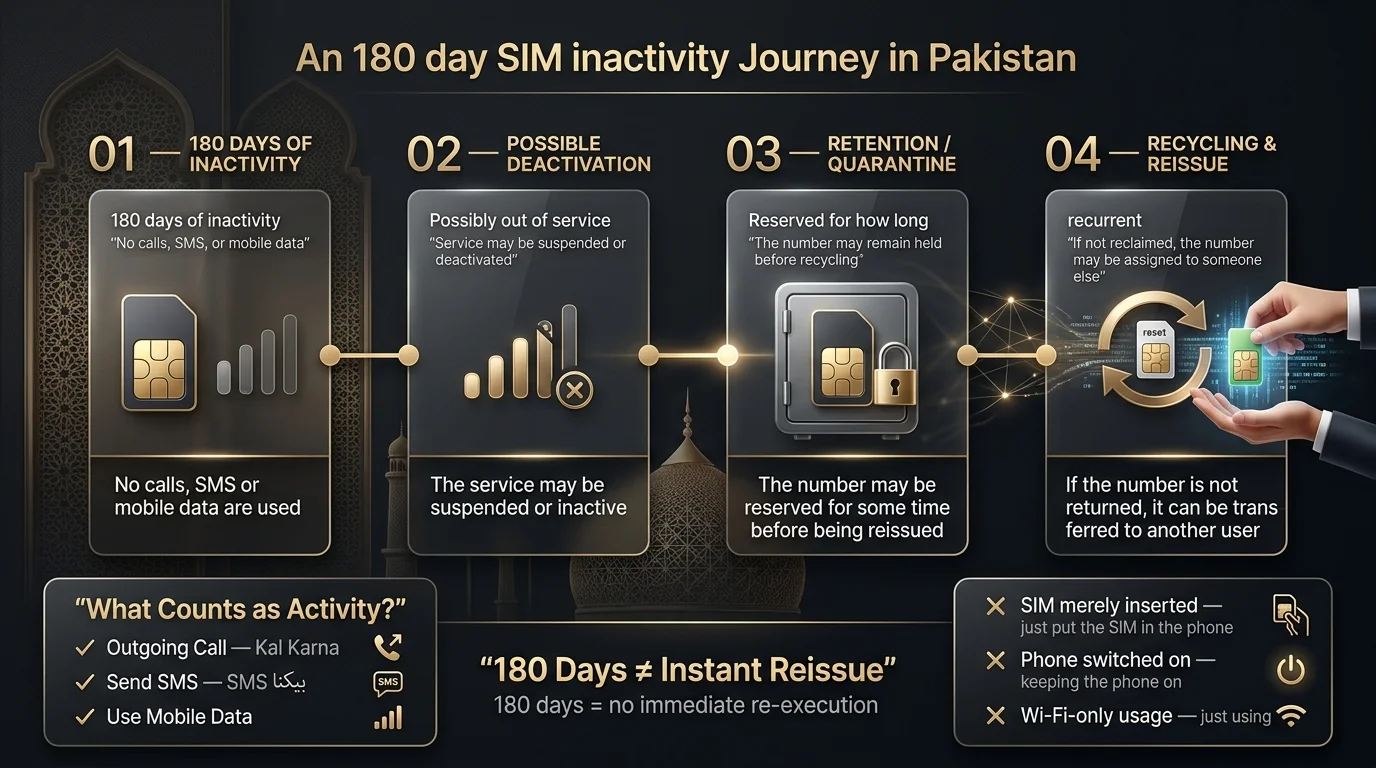
What Happens When a SIM Reaches 180 Days of Inactivity?
- Inactivity: A SIM enters an inactive state when it has no usage, such as calls, SMS, or mobile data, for 180 days, although the operator may still keep it technically active during this period.
- Deactivation or Suspension: After 180 days of inactivity, an operator may deactivate the SIM, which stops incoming and outgoing services. Some operators may apply a temporary suspension before permanent deactivation.
- Retention or Quarantine: After deactivation, the operator may hold the number for a specific period, allowing the original subscriber to reclaim it. The retention period varies by operator and may extend to several months.
- Recycling: If the original subscriber does not reclaim the number within the applicable retention period, the operator may recycle it and make it available for reassignment.
- New Subscriber: Once an operator reassigns a recycled number to a new customer, the previous subscriber generally loses any claim to the number and should update accounts that were linked to it.
Can Your Mobile Number Be Reissued to Someone Else?
- SIM vs. Mobile Number: A SIM card and a mobile number (MSISDN) are different. The operator associates the SIM with your subscriber account, while the operator manages and assigns the mobile number.
- SIM Deactivation: An operator may deactivate a SIM after a prolonged period of inactivity.
- Number Recycling: After the applicable retention period, the operator may recycle the MSISDN and reassign it to another subscriber.
- Loss of Number Rights: Once an operator legally reassigns a number to a new subscriber, the previous subscriber generally cannot claim or recover it.
- CNIC Registration: Registering a number against your CNIC does not guarantee permanent access to that number if the operator later deactivates and reassigns it.
Can You Recover a SIM After 180 Days of Inactivity?
- Active SIM: If the SIM shows signal, make a call or use data to confirm service is working. Continue using it to prevent repeat issues.
- Suspended Service: Contact the operator to check if reactivation is possible and complete required identity verification.
- Disconnected Number: Inquire with the operator about the recoverability of the number.
- Recycled Number: Recovery is generally not possible once the number has been reassigned to another subscriber.
What information should you have ready?
- Original and valid CNIC (expired CNIC may cause issues)
- Mobile number in question
- SIM information (physical SIM card, if available)
- Name of the operator/network
- Additional proof or verification documents as requested by the operator’s staff.
180-Day SIM Rules for Jazz, Zong, Ufone, Telenor/PTCL and SCO
| Network | Inactivity provision | What may happen | Recovery/retention | Source |
| Jazz | The text highlights an 180-day inactivity threshold per PTA rules and mentions a 90-day “active base” followed by a roughly 180-day quarantine, as described by a Jazz representative. | The operator may deactivate the SIM, but it reportedly does not fully recycle the number for a new customer until the dormancy period extends much further, described in the same account as up to 720 days. | You can request reactivation by visiting the operator’s franchise with your CNIC and completing biometric verification, provided the operator has not yet recycled the number. | PTA statements; Jazz official quoted in Dawn |
| Zong | Subject to the same PTA-mandated 180-day inactivity rule as other operators. | Disconnection after 180 days of no calls/SMS/data, with potential reissue afterward. | Franchise-based reactivation with CNIC/biometric verification, where the number is still available. | PTA statements; general operator reporting |
| Ufone | Subject to the same PTA-mandated 180-day inactivity rule. Ufone and Telenor Pakistan have merged operations. | Disconnection/reissue process consistent with the general PTA rule. | Reactivation available through Ufone service centers if not yet recycled. | PTA statements; general operator reporting |
| Telenor/PTCL | Subject to the same PTA-mandated 180-day inactivity rule; Telenor Pakistan’s mobile operations are now part of the merged Ufone/Telenor entity. | Disconnection/reissue consistent with the general PTA rule. | Reactivation through official service centers/helpline, if not yet recycled. | PTA statements; general operator reporting |
| SCO (SCOM) | SCO, the government-run operator serving Azad Jammu & Kashmir and Gilgit-Baltistan, operates under the same PTA regulatory umbrella as the commercial operators. | Specific internal inactivity procedures for SCOM are not independently documented in the sources reviewed here; treat the general PTA 180-day rule as the applicable baseline. | Contact SCO/SCOM customer service directly for reactivation procedures in AJK/GB. | PTA’s general regulatory authority over all licensed operators; SCO organizational background |
The 180-day inactivity threshold for SIMs is a PTA-wide rule applicable to Jazz, Zong, Ufone, Telenor, and SCO.
- Jazz: Treats the first 90 days as active, then has a quarantine of about 180 days before potential recycling, which may take up to 720 days.
- Zong: Adheres to the 180-day dormancy rule, but no additional operator-specific details were available.
- Ufone: Follows the standard 180-day rule and operates under a merged entity with Telenor.
- Telenor: Governed by the 180-day rule; mobile operations have merged with Ufone. PTCL operates separately as a fixed-line provider.
- SCO: As a government-operated network, it follows PTA regulations but lacks detailed, publicly confirmed procedures for inactivity and recycling. Contact customer service for specifics.
Is the 180-Day SIM Rule the Same as 180-Day Balance Validity?
The text outlines two distinct concepts introduced by the PTA regarding SIM card regulations in 2026:
- 180-day SIM Inactivity: This rule concerns the actual use of the SIM (calls, texts, data) over 180 days. Extended inactivity can lead to deactivation and recycling of the number.
- 180-day Prepaid Balance Validity: This newer policy mandates a minimum 180-day validity for prepaid balances, preventing the forfeiture of unused recharge due to a shorter validity window. This rule aims to protect lower-income users and ensures that any balance expiring during active SIM usage is automatically reinstated.
It’s important to note that while the balance validity protects funds, it does not allow for indefinite inactivity of the SIM, as the 180-day inactivity rule still applies.
Comparison table
| Issue | SIM inactivity | Balance validity |
| What is affected? | The SIM/service connection itself | The recharge/balance amount on the account |
| What triggers it? | An extended stretch (180 days) with no calls, SMS, or data usage | The expiry period attached to a specific recharge/top-up |
| Does it mean the number is automatically recycled? | Potentially, at a later stage, after deactivation and quarantine | No — this rule is about preserving your balance, not your number |
| Same rule? | No | No |
What Happens to WhatsApp, Banking and OTPs If Your Number Is Reissued?
An old or forgotten SIM can create security and account-access risks, especially after the operator deactivates and eventually reassigns the number to another subscriber. You can reduce these risks by updating your registered phone numbers before they become inactive.
- WhatsApp: WhatsApp links accounts to phone numbers. If you lose access to an old number, you may face problems accessing your account, history, or contacts. A new subscriber could also attempt to register the recycled number on WhatsApp.
- Banking: Banks often use registered mobile numbers for OTPs, transaction alerts, and account recovery. Losing access to an old number can prevent you from receiving OTPs or recovering your account.
- Easypaisa and JazzCash: Mobile wallets associate accounts with registered phone numbers. If you keep an inactive number linked to your wallet, you may lose access to your balance or face verification problems.
- Social Media Accounts: Old phone numbers can remain connected to accounts such as Google, Facebook, and Instagram. Update or remove inactive numbers from your account recovery settings.
- Two-Factor Authentication (2FA): If you use SMS-based 2FA with an inactive number, replace it with your current number or switch to an authenticator app where possible.
How to Keep Your SIM Active for More Than 180 Days
- Use Your SIM Regularly: Make calls, send SMS messages, or use mobile data periodically to keep the number active.
- Perform Qualifying Activities: Use services such as calls, SMS, or mobile data, as applicable under your operator’s activity rules.
- Don’t Rely on SIM Insertion: Simply keeping the SIM inserted in your phone does not necessarily count as active usage.
- Monitor Your SIM Status: Check your service status if you have not used the SIM for an extended period.
- Keep Your Information Updated: Make sure your CNIC and account details remain valid and up to date to reduce the risk of service-related issues.
- Check Requirements Before Traveling: If you plan to stay abroad for an extended period, check your operator’s requirements to help protect your number from deactivation.
- Act Before Deactivation: Take action before your SIM stops working to reduce the risk of suspension, quarantine, or eventual number recycling.
How Can Overseas Pakistanis Keep Their Pakistani SIM Active?
Long stays abroad can lead to a SIM crossing 180 days without activity, causing overseas Pakistanis to lose access to important services. The PTA has introduced a program to help users protect their SIMs from deactivation while living overseas. Key points:
- Designed for Long-Term Travelers: The program supports users who stay abroad for extended periods and cannot regularly use their normal mobile services.
- Consider Roaming: Roaming can generate SIM activity, but it may involve additional charges and higher costs.
- Protect Account Access: Long periods of inactivity can increase the risk of losing access to accounts linked to your mobile number.
- Protect OTP Access: Many users rely on their original SIM to receive OTPs for banking, email, social media, and other important accounts.
- Contact Your Operator: Before relying on the service, contact your mobile operator, confirm that the SIM remains registered in your name, and check any applicable charges or requirements.
How to Check Whether Your SIM Is Still Active
- Make a call: Check if the call connects to see if the SIM is functioning.
- Send an SMS: Confirm service by sending a text and receiving delivery confirmation.
- Test mobile data: Use cellular data to browse or load an app to verify data service.
- Check operator’s account/app: Use available portals or apps to check SIM/account status.
- Contact customer support: If issues persist, call the operator’s helpline for assistance.
What Should You Do If Your SIM Has Already Been Blocked?
- Identify the Operator: Confirm which mobile operator issued the affected number.
- Check the SIM Status: Find out whether the operator has temporarily suspended the number or permanently disconnected it.
- Contact Official Support: Contact the operator’s official customer support or visit an authorized service center.
- Complete Verification: If required, complete identity or biometric verification and bring your original CNIC.
- Ask About Reactivation: Confirm whether the operator can restore the number and whether it remains within the applicable retention period.
- Update Your Accounts: If the operator has already recycled the number, immediately update your phone number on important accounts, banking services, mobile wallets, email, and two-factor authentication settings.
Final Verdict
A SIM card in Pakistan that remains unused for 180 days risks deactivation by operators as per PTA regulations. The deactivation process varies by operator and does not happen immediately after 180 days. It’s important to distinguish between this rule and the separate 2026 policy on the validity of a prepaid balance. If the SIM is linked to vital accounts like banking or WhatsApp, it’s advisable to update the associated information before losing access to the number. If you haven’t used your Pakistani SIM for several months, check its status promptly.
پاکستان میں ایک سم کارڈ جو 180 دنوں تک غیر استعمال شدہ رہتا ہے، پی ٹی اے کے ضوابط کے مطابق آپریٹرز کے ذریعے غیر فعال ہونے کا خطرہ ہے۔ غیر فعال کرنے کا عمل آپریٹر کے لحاظ سے مختلف ہوتا ہے اور 180 دنوں کے بعد فوری طور پر نہیں ہوتا ہے۔ اس اصول اور پری پیڈ بیلنس کی درستگی پر الگ الگ 2026 پالیسی کے درمیان فرق کرنا ضروری ہے۔ اگر سم بینکنگ یا واٹس ایپ جیسے اہم اکاؤنٹس سے منسلک ہے، تو مشورہ دیا جاتا ہے کہ نمبر تک رسائی کھونے سے پہلے متعلقہ معلومات کو اپ ڈیٹ کر لیں۔ اگر آپ نے کئی مہینوں سے اپنی پاکستانی سم استعمال نہیں کی ہے تو فوری طور پر اس کا اسٹیٹس چیک کریں۔
Frequently Asked Questions
What happens if I don’t use my SIM for 180 days in Pakistan?
After 180 days of inactivity, your mobile operator may deactivate the SIM. The number may then enter a retention or quarantine period. If you do not reclaim it within the applicable period, the operator may eventually recycle and reassign the number to another subscriber.
Will my SIM automatically be blocked after 180 days?
Not necessarily. The operator does not have to block the SIM at the exact moment it reaches 180 days. Operators may follow their own internal procedures, including active-base and quarantine periods, which can extend the actual timeline before deactivation or reassignment.
Can my number be reissued after 180 days?
Potentially, but typically only after a further retention/quarantine period beyond the initial 180-day inactivity window, not immediately at day 180.
Can I recover an inactive SIM?
Often yes, if it hasn’t yet been recycled to a new subscriber. Visit your operator’s official service centre with your CNIC for reactivation and biometric verification.
Does making one call keep my SIM active?
Yes, an outgoing call is one of the qualifying activities PTA recognizes, and it should reset the inactivity window.
Does sending an SMS count as SIM activity?
Yes, sending a text message is explicitly one of the recognized qualifying activities.
Does Mobile Data Count as SIM Usage?
Yes. Using mobile data counts as SIM activity, along with making calls and sending SMS messages. Regularly using these services can help prevent your SIM from becoming inactive under the applicable inactivity rules.
Does Receiving a Call Reset the Inactivity Period?
PTA’s public guidance does not clearly confirm that receiving an incoming call resets the inactivity period. Its guidance focuses on activities such as making calls, sending SMS messages, and using mobile data. Therefore, you should not rely on incoming calls alone to keep your SIM active.
Disclaimer
This article provides general information and does not constitute legal or professional advice. Telecom authorities and mobile operators may change their rules, requirements, and procedures over time. Operators may also maintain internal policies that they do not publicly document.
When authoritative sources do not clearly confirm specific details, this article states that limitation rather than presenting uncertain information as fact. For important decisions involving SIMs, accounts, or telecom services, verify the latest requirements directly through the PTA or your mobile operator’s official channels.
Sources & References
- Pakistan Telecommunication Authority (PTA) is the official regulator responsible for SIM inactivity and balance validity rules.
- Overseas Pakistanis can take steps to avoid mobile SIM deactivation, as highlighted by Daily Pakistan.
- SIMs inactive for 6 months are subject to blockage, according to the SAMENA Council and Pakistan Observer.
- PTA has issued a policy for 180-day balance validity and automatic reinstatement for prepaid users.
- There are warnings regarding SIM suspension due to invalid CNICs and inactivity.
- The PTA is enforcing a uniform SIM policy across telecom operators, with comments from a Jazz official.
- PTA has fined major telecom operators, including Jazz, Zong, Ufone, and Telenor, for illegal SIM activations.
- A guide is available for reactivating expired SIMs from various operators.
[…] Read ALso: 180 Days of SIM Inactivity in Pakistan […]