Is Sharing a SIM Illegal in Pakistan? PTA Warning, Risks & What to Do
The Pakistan Telecommunication Authority (PTA) has emphasized that SIM cards registered in a person’s name are legally their responsibility, regardless of the user. Sharing SIM cards can lead to legal issues for the registered owner. Citizens should monitor their SIMs linked to their Computerized National Identity Cards (CNICs). The article discusses the risks of SIM sharing, legal consequences, how to check linked SIMs, actions if someone else is using your SIM, and ways to prevent SIM and biometric fraud.
پاکستان ٹیلی کمیونیکیشن اتھارٹی (پی ٹی اے) نے اس بات پر زور دیا ہے کہ کسی شخص کے نام پر رجسٹرڈ سم کارڈز قانونی طور پر ان کی ذمہ داری ہیں، چاہے صارف کوئی بھی ہو۔ سم کارڈز کا اشتراک رجسٹرڈ مالک کے لیے قانونی مسائل کا باعث بن سکتا ہے۔ شہریوں کو چاہیے کہ وہ اپنے کمپیوٹرائزڈ قومی شناختی کارڈز (CNICs) سے منسلک اپنی سموں کی نگرانی کریں۔ مضمون میں سم شیئرنگ کے خطرات، قانونی نتائج، منسلک سمز کو چیک کرنے کا طریقہ، اگر کوئی اور آپ کی سم استعمال کر رہا ہے تو اس کے لیے اقدامات، اور سم اور بائیو میٹرک فراڈ کو روکنے کے طریقوں پر بحث کرتا ہے۔
What Is the PTA Warning About?
- SIM Registration Rules: You cannot give your registered SIM to someone else, as it leaves you legally exposed for any actions taken with that number.
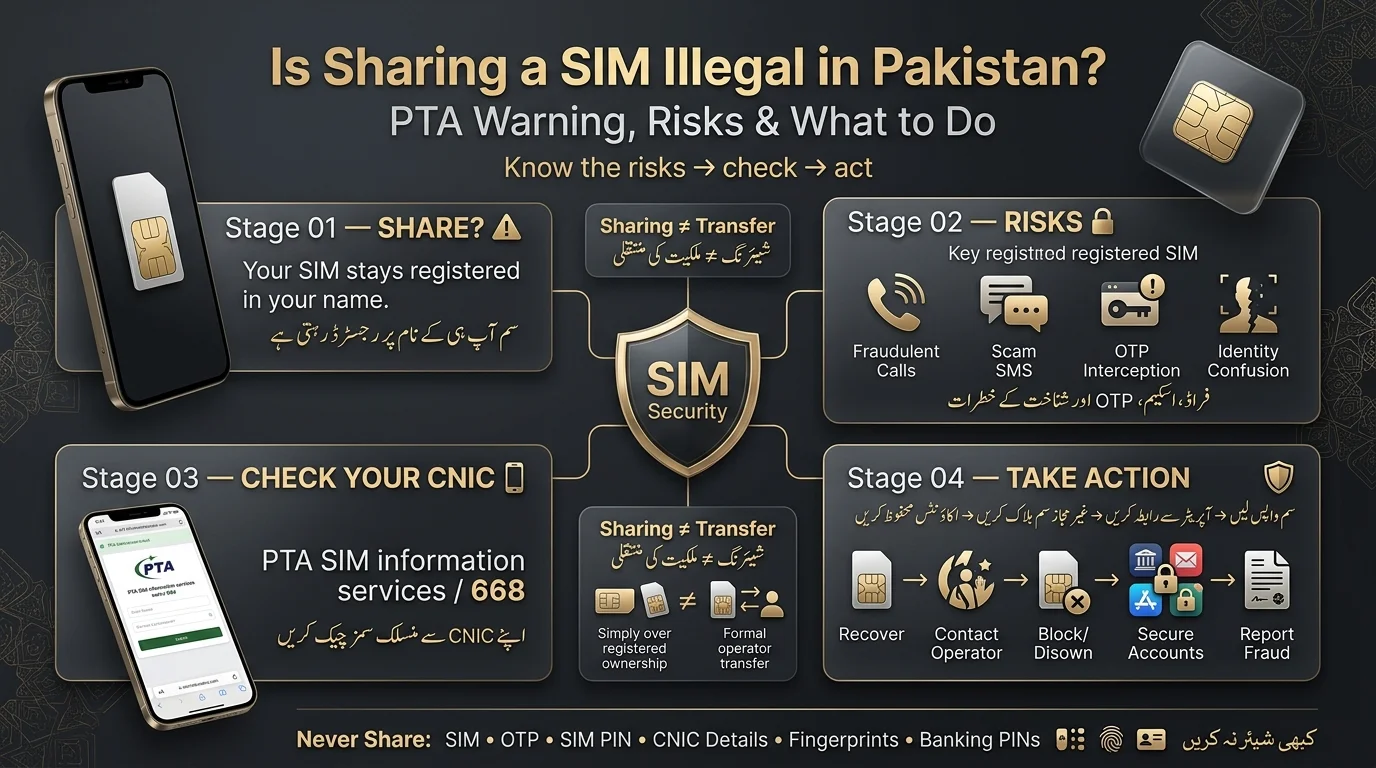
- Ownership vs. Lending: There is a difference between temporarily lending a SIM (keeping it registered in your name) and formally transferring ownership (which changes legal accountability).
- Fraud Risks: Unauthorized use of a registered SIM complicates accountability and can enable fraud.
- Legal Consequences: The practice is considered a punishable offense, but specific penalties are not detailed in the advisories. For precise laws, refer to PTA communications or the Prevention of Electronic Crimes Act (PECA) 2016.
What Did PTA Say About Sharing SIMs?
The PTA has consistently advised citizens not to share their registered SIM cards or allow unauthorized usage, as it is a criminal offense that may lead to legal penalties. Each individual should monitor and control their SIMs associated with their CNIC. The warnings stress that misuse of a SIM registered in someone’s name can wrongly implicate that individual in illegal activities. This advisory is a reminder of existing laws rather than a new regulation, and it reinforces long-standing biometric SIM registration requirements in Pakistan. While there are statutory penalties under existing laws, specific fines or jail terms mentioned in unverified social media claims should be approached cautiously.
Why You Should Never Share Your SIM
- The SIM card is registered to your name, and relinquishing it does not change the registration.
- A SIM in someone else’s possession could be used for scams, impersonation, and other fraudulent activities, all traced back to your CNIC.
- Many important accounts (banking, social media, etc.) are linked to your mobile number, putting them at risk if the SIM is misused.
- The person with the SIM card can access your incoming messages and calls, including sensitive verification codes.
- If the number is used for illegal activities, investigations will typically start with the registered subscriber, leading to a stressful process for them.
What Can Happen If Someone Misuses Your SIM?
- Fraudulent Calls: Your number can be used by someone posing as a bank representative or government official to scam others.
- Scam SMS: Your number may be exploited to send deceptive text messages, including fake prizes and phishing links.
- Account Access: If linked to accounts, the person with your SIM could intercept one-time passwords (OTPs) and access your accounts.
- Identity Confusion: Authorities may initially assume that any activity on the number is linked to the registered subscriber.
- Clarification: Holding the SIM in your name does not imply you committed the acts carried out through it; it merely identifies you for inquiries into misuse.
SIM Sharing vs SIM Swap vs SIM Cloning
These terms get used interchangeably, but they describe different problems.
| Threat | What happens | Main risk |
| SIM sharing | You give your physical SIM to someone else | Unauthorized use under your identity |
| Unauthorized SIM registration | A number is registered using your identity without your knowledge | Identity/SIM fraud |
| SIM swap | Your number is moved onto another SIM (often by tricking or bribing a franchise) | OTP interception, account takeover |
| SIM cloning | SIM credentials are unlawfully duplicated onto another card | Unauthorized calls/messages sent as you |
| Biometric fraud | Your fingerprint or identity data is misused to register a SIM | Unauthorized SIM issued in your name |
What is SIM swap fraud?
SIM swap fraud involves a fraudster persuading or bribing a telecom retailer to transfer a victim’s phone number to a SIM card they control. As a result, the victim’s original SIM becomes inactive, allowing the fraudster to intercept the victim’s calls, texts, and one-time passwords (OTPs).
Why SIM swap is especially dangerous
The text outlines the risks of losing cellular service, including the interception of OTPs and harmful account-recovery processes. It stresses the importance of the PTA’s guidance on SIM sales, biometric verification, and the prohibition against sharing SIM cards. Additionally, it mentions that the PTA fined major mobile operators Rs. 740 million for SIM issuance violations, highlighting that SIM fraud poses risks for both consumers and operators.
How to Check SIMs Registered Against Your CNIC
- Use the PTA SIM information service via the online portal cnic.sims.pk to check how many SIMs are registered against your CNIC.
- Alternatively, send your 13-digit CNIC number via SMS to 668 to receive the count of registered SIMs.
- After checking, look for any unfamiliar numbers or old accounts you no longer use.
- If you find an unknown SIM, take action rather than ignoring it.
What to Do If Someone Else Has Your SIM
- Recover the SIM if safe to do so.
- Contact your mobile operator for assistance and guidance.
- Verify your registered SIMs through cnic.sims.pk or by calling 668.
- Block or disown unauthorized connections, potentially requiring identity verification.
- Secure linked accounts by updating security on banking apps and social media.
- Report suspected fraud to PTA and, for financial or cybercrime, to the NCCIA.
Can You Give Your SIM to a Family Member?
- SIM registration records remain in your name, regardless of who uses it, so you remain accountable.
- Allowing an employee to use your SIM poses risks similar to lending it to anyone else, with potentially less oversight.
- Lending your SIM temporarily still keeps legal responsibility with you.
- The safer alternative for long-term use is to register a separate SIM in the other person’s name or formally transfer ownership through your operator.
SIM Ownership Transfer vs Sharing
- Sharing a SIM card means the physical card can change hands, but the registration stays with the original subscriber, maintaining legal responsibility.
- A legitimate ownership transfer must go through the mobile operator’s formal process, involving both parties’ CNICs and biometric verification to update the registration record.
Consider a transfer when:
- A number will permanently be used by someone else.
- A family member is taking over a line permanently.
- A business number is changing due to an employee or role change.
- An old number is being used long-term by someone other than the original registrant.
- Possession of a SIM does not equal ownership; only a formal transfer updates the responsibility in the records.
PTA Warning About Fingerprints and Free SIM Scams
- Common scams related to SIM registration often involve attractive offers such as free SIMs or claims of government schemes.
- Fraudsters may impersonate telecom representatives or approach individuals for fingerprint scans in unauthorized settings.
- Fingerprint verification is a critical part of legitimate SIM registration in Pakistan and should only occur through authorized channels.
- Red flags to watch out for include unsolicited offers of free SIMs, pressure to provide a fingerprint, requests for CNIC information, lack of official branding, and promises of free benefits tied to SIM registration.
Never Share These SIM and Identity Details
- Your physical SIM card
- One-time passwords (OTPs)
- Your SIM PIN
- CNIC information, shared unnecessarily
- Photographs of your CNIC with unknown people or unofficial channels
- Fingerprints or other biometric verification, outside official processes
- Banking OTPs
- Mobile-wallet PINs
- Account passwords
Important distinction
A legitimate telecom verification process should be conducted through authorized franchises, official operator apps, or PTA channels. It is important to avoid sharing sensitive information with unknown individuals. Always verify through official channels before sharing any information when in doubt.
10 SIM Security Tips for Pakistan
- Keep your registered SIM with you at all times.
- Don’t lend your SIM to anyone, even briefly.
- Never share OTPs, even with someone claiming to be from your bank or operator.
- Don’t share account PINs with anyone.
- Checking the SIMs linked to your CNIC periodically, every few months, is a reasonable habit.
- Remove or block numbers you no longer use.
- Buy new SIMs only through official, authorized telecom franchises.
- Never accept free SIM offers from unofficial sources.
- Contact your operator immediately if you lose a SIM or your phone.
- Review and secure every account linked to your phone number — banking, email, and social media especially.
Where Can You Report SIM Fraud or Unauthorized SIM Registration?
- Mobile Operator: Contact your mobile operator for issues like lost SIMs, unauthorized use, number blocking, replacements, or ownership questions.
- PTA: For telecom-related complaints (e.g., unauthorized SIM issuance), use the PTA helpline (0800-55055) or their online portal.
- Cybercrime Authority: For fraud or identity theft via a SIM, report to the National Cyber Crime Investigation Agency (NCCIA) at helpline 1799 or their complaint portal.
- Financial Institution: If a compromised SIM affects banking, immediately contact your bank or wallet provider to secure your account.
Safety Tip: Always use official websites and contact numbers to avoid unofficial or outdated information.
Conclusion
The PTA’s 2026 advisories include three key recommendations:
- Track all SIMs registered in your name.
- Regularly check and remove any unknown or unnecessary SIMs linked to your CNIC.
- If you find someone using a number in your name, contact your mobile operator, the PTA, or the NCCIA immediately.
Avoid relying on unverified information from social media; consult official PTA communications for accurate details.
FAQ’s
Is it illegal to share a SIM in Pakistan?
PTA advisories describe handing over a SIM registered in your name as a punishable practice that can carry legal consequences, though the exact penalty depends on the specific circumstances and applicable law.
Can I give my SIM to a family member?
No, the registration stays under your name and your responsibility regardless of the relationship, so it carries the same risk as lending it to anyone else.
Am I responsible if someone uses my registered SIM?
You remain the accountable name on record, and investigations generally start with you, which is exactly why PTA advises against sharing SIMs in the first place.
How can I check SIMs registered against my CNIC?
Use the official portal at cnic.sims.pk, or send your 13-digit CNIC number (no dashes) via SMS to 668.
Can I transfer my SIM to another person?
Yes, through your operator’s formal ownership-transfer process, which is different from simply handing over the physical card.
Disclaimer
This article provides general information and does not constitute legal advice. It covers telecom regulations and penalties based on PTA statements and news available as of August 2026. Authorities may update these rules, fees, and procedures over time.
For specific cases or legal concerns, consult the PTA’s official website, your mobile operator, or a qualified legal professional. Always verify contact details, complaint procedures, and regulatory requirements through official PTA and NCCIA channels, as these details may change.
Sources & References
The text provides an overview of recent advisories and warnings from the Pakistan Telecommunication Authority (PTA) regarding the unauthorized use of SIM cards. Key points include:
- Advisory against the unauthorized use of SIM cards, issued on June 6, 2026.
- Warnings to users about using SIMs registered in others’ names and sharing SIM cards.
- Over 1.8 million phone SIMs were blocked by the PTA over seven months as of August 2026.
- A new advisory on SIM security measures was released on June 6, 2026.
- A warning to mobile users about the misuse of registered SIMs was issued on July 24, 2026.
- Information on cybercrime reporting and operations of the National Cyber Crimes Investigation Agency (NCCIA) is available through official channels.
- Methods for checking SIM registrations include a dedicated website and SMS-based verification.
Readers are encouraged to verify information directly with the PTA, as figures may vary between sources.