PTA SIM Information System Explained: How Pakistan’s Verification Network Connects
The Article discusses the PTA SIM Information System in Pakistan, which allows mobile phone users to check how many SIMs are registered under their CNIC by sending a text to 668. It emphasizes that this process is supported by a broader regulatory framework that includes the Pakistan Telecommunication Authority, NADRA, and mobile operators. The piece is not just a how-to guide but aims to provide insight into the connections between CNIC records, biometric identity checks, and operator databases. Understanding this system is essential for consumers to know what SIMs are legally associated with their identities and to address any discrepancies.
آرٹیکل پاکستان میں PTA سم انفارمیشن سسٹم پر بحث کرتا ہے، جو موبائل فون صارفین کو 668 پر ایک ٹیکسٹ بھیج کر یہ چیک کرنے کی اجازت دیتا ہے کہ ان کے CNIC کے تحت کتنی سمز رجسٹرڈ ہیں۔ یہ ٹکڑا صرف رہنمائی کرنے کا طریقہ نہیں ہے بلکہ اس کا مقصد CNIC ریکارڈز، بائیو میٹرک شناختی چیکس، اور آپریٹر ڈیٹا بیس کے درمیان رابطوں کی بصیرت فراہم کرنا ہے۔ اس نظام کو سمجھنا صارفین کے لیے ضروری ہے کہ وہ یہ جان سکیں کہ کون سی سمز قانونی طور پر ان کی شناخت کے ساتھ منسلک ہیں اور کسی بھی تضاد کو دور کرنے کے لیے۔
What Is the PTA SIM Information System?
The Pakistan Telecommunication Authority (PTA) regulates mobile operators in relation to SIM card registration and management. It maintains a centralized SIM registration framework linked to Computerized National Identity Cards (CNICs), known as the PTA SIM Information System. Launched in October 2009, the public-facing part allows users to check SIM registrations linked to their CNIC via SMS. Over the years, the system has evolved to include online verification, biometric activation, and greater collaboration between PTA, NADRA, and mobile operators, ensuring that each SIM has a verifiable owner.
Why Was the PTA SIM Information System Created?
Before centralized verification systems became widely implemented, Pakistan’s telecom sector faced problems involving unverified SIMs, identity misuse, and fraud. The SIM Information System (668) was introduced to help address these concerns by allowing users to check the number of SIMs registered against their own CNIC.
Key developments included:
- 2009: Launch of the SIM Information System.
- 2012: Expansion of automated documentation and verification for new SIM sales.
- 2014: Introduction of biometric verification for SIM activation.
- 2015: Nationwide re-verification drive for older SIMs.
These efforts enhanced accountability and consumer protection within the telecom industry.
How Does the PTA SIM Verification Network Work?
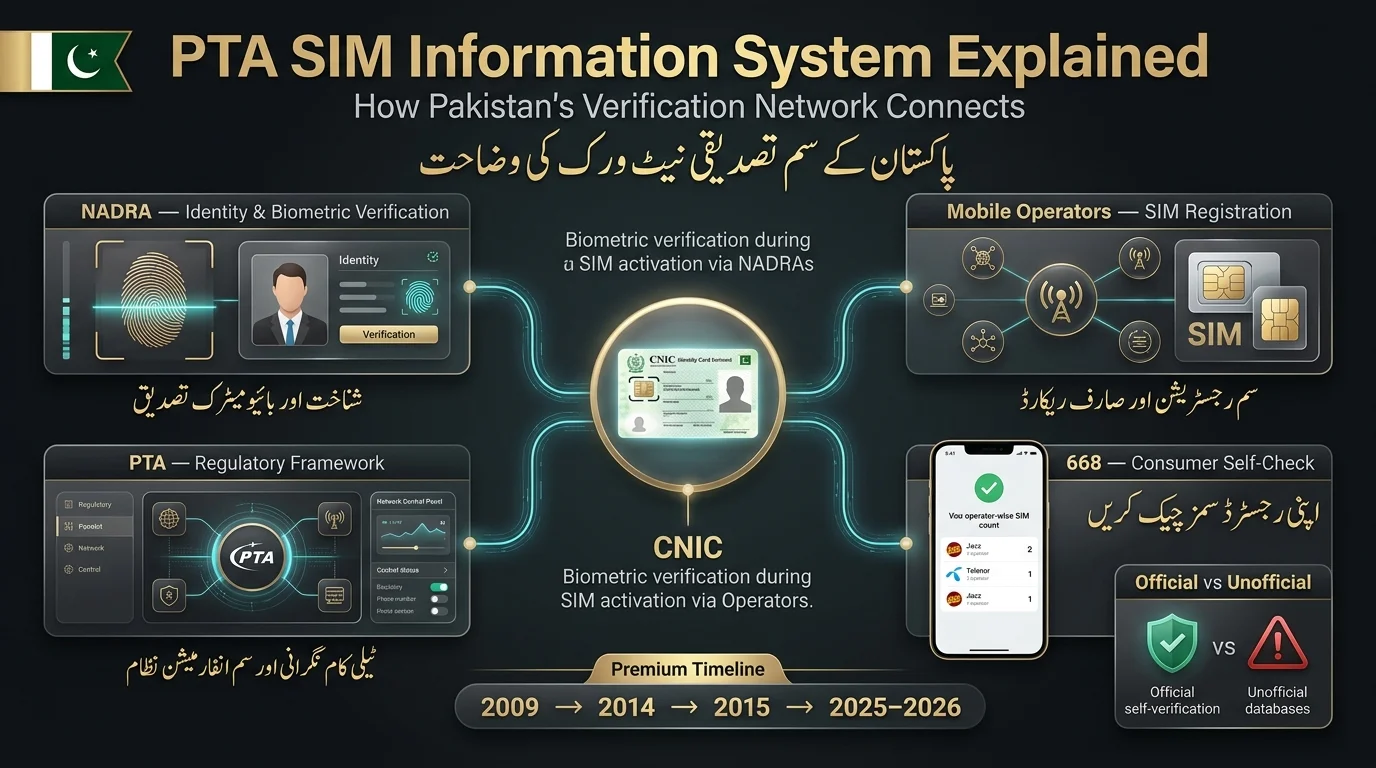
The PTA SIM Information System connects a subscriber’s CNIC to biometric identity verification, mobile operator registration, and regulatory oversight. The activation process involves the following steps:
- CNIC holder initiates SIM registration or verification.
- NADRA checks identity (if applicable).
- Details are registered with the mobile operator.
- Information is linked to PTA’s SIM infrastructure.
- Consumer verification is conducted via services like 668.
While the system reflects a regulatory intent and shows a clear public-facing outcome, the exact internal connections and API details are not publicly disclosed. The consumer-facing service, 668, uses the CNIC to search SIM records and provide an operator-wise count. A simplified flow visualization shows the interaction between the CNIC, NADRA, mobile operators, and PTA.
PTA vs NADRA vs Mobile Operators: Who Does What?
The text clarifies the distinct roles of PTA, NADRA, and mobile operators in Pakistan:
- PTA (Pakistan Telecommunication Authority): Acts as the telecom regulator, setting SIM registration rules, ensuring operator compliance, and managing consumer interaction via the SIM information framework. Its focus is on regulation and consumer protection, not identity verification.
- NADRA (National Database and Registration Authority: Serves as Pakistan’s national identity authority, maintaining master CNIC records and providing identity authentication through biometric verification, which mobile operators depend on for verifying identities.
Mobile Operators
Cellular companies, such as Jazz, Zong, Telenor, and Ufone, are responsible for issuing SIMs, registering subscribers, and maintaining customer records. They also manage processes like SIM ownership transfers and addressing unauthorized registrations.
| Organization | Main Role |
| PTA | Telecom regulation and SIM information framework |
| NADRA | Identity and CNIC verification, biometric authentication |
| Mobile Operators | SIM issuance and subscriber record-keeping |
| Consumer | Checks registrations and reports discrepancies |
The text highlights that various organizations each have distinct roles and responsibilities that do not overlap. Specifically, the PTA is not responsible for verifying fingerprints, NADRA does not issue SIMs, and operators do not set national identity policy. Each organization relies on the others without replacing their functions.
What Is 668 in Pakistan?
668 is Pakistan’s SIM verification short code. Users send their CNIC via SMS to receive a count of SIMs linked to it and the corresponding mobile operators. The service does not disclose personal details or phone numbers.
How the 668 Query Works
- The user sends their CNIC number (without dashes) via SMS to 668.
- The verification system receives the request.
- Relevant SIM registrations tied to that CNIC are checked across operators.
- The results are grouped and counted by mobile operator.
- The consumer receives an SMS response with the breakdown.
Checking a SIM count via 668 is a self-verification tool, not access to private subscriber information.
How NADRA Biometric Verification Fits Into SIM Registration
Biometric verification is used to confirm identity during the sale or activation of SIM cards, rather than checking records afterward. This system started in 2014, with nationwide biometric activation beginning on August 1 of that year. When purchasing a new SIM or activating a replacement, individuals must have their fingerprints matched with NADRA’s records to complete the transaction.
Why Biometric Verification Was Introduced
- To reduce identity theft tied to fraudulently registered SIMs.
- To confirm that the person physically present at the point of sale is the actual CNIC holder.
- To prevent SIMs from being issued using someone else’s identity without their knowledge.
- To improve the overall accuracy and reliability of subscriber records nationwide.
BVS vs 668
These two pieces are easy to mix up, so it’s worth stating the distinction plainly:
- Biometric Verification System (BVS): the identity-verification mechanism used at the point of SIM sale or activation, confirming the buyer is who they claim to be.
- 668: the consumer-facing information/checking mechanism used afterward, letting a CNIC holder review how many SIMs already exist against their name.
One happens before a SIM goes live; the other lets you audit what’s already on record. They serve different purposes, and neither replaces the other.
How to Check SIMs Registered Against Your CNIC
To check your SIM count in Pakistan, PTA offers two official methods:
- PTA Online SIM Information Service: Visit the PTA online portal, enter your CNIC, and retrieve operator-wise SIM information.
- SMS 668: Send your 13-digit CNIC (without dashes) to 668. You’ll receive a response listing the registered SIMs by mobile company. Standard SMS charges may apply.
Always use these official channels, as unofficial websites may pose privacy risks and provide inaccurate information.
What Information Does the PTA SIM Information System Show?
When checking your CNIC through official channels, you can see which mobile operators have SIMs registered to your CNIC, the count of SIMs per operator, and confirmation of the CNIC-to-SIM association. However, the system does not provide live location tracking, call histories, private messages, unrestricted details on other SIM registrations, or any private data related to someone else’s CNIC. Be cautious of services that promise such information through a CNIC lookup, as they exceed the intended functionality of the PTA system.
What to Do If You Find an Unauthorized SIM on Your CNIC
- Mismatched SIM counts are common, and the PTA has a process to resolve them.
- Verify your CNIC number and the operator breakdown received.
- Identify the operator linked to the unrecognized SIM.
- Contact the operator’s customer service to request disowning or correction of the SIM record.
- Keep any confirmation numbers from the process.
- If unresolved, escalate the issue to PTA through complaint channels.
- Both older and current PTA guidelines recommend contacting the relevant service provider for unauthorized SIM registrations.
Read Also: Lost Your SIM Card in Pakistan
PTA SIM Information System Timeline: 2009 to Today
- 2009: Introduction of SIM Information System 668, enabling consumers to check SIM counts against their CNIC.
- 2012: Automation of SIM sale documentation and verification processes; related PTA projects include SIM Information Systems 667 and 668.
- 2014: Implementation of biometric SIM verification, requiring fingerprint matching for activation.
- 2015: Major SIM re-verification exercise for connections registered before biometric checks.
- 2025-2026: Ongoing tightening of identity and biometric enforcement, with efforts to link SIMs to expired or deceased CNIC holders and combat identity fraud.
Overall, each development aimed to address gaps in fraud and inaccuracies from previous stages.
PTA SIM Information System vs Unofficial SIM Databases
The genuine PTA framework is regulated, while many unofficial websites falsely claim to provide complete SIM ownership lookups for unrelated numbers or people.
| Official Verification | Unofficial Database |
| Part of a defined regulatory ecosystem | Source and legitimacy often unknown |
| Based on CNIC self-verification | May claim to reveal personal details of others |
| Designed for consumer self-checks | Often privacy-invasive by design |
| Operates within a government/telecom framework | No accountability or oversight |
| Built for legitimate identity verification | Can create real security and privacy risks |
Be skeptical of websites that claim to reveal a stranger’s SIM ownership details solely from a phone number or CNIC. Legitimate systems prioritize self-verification rather than providing open access to others’ private information.
Conclusion
In this article, we will explain the interconnected system of identity verification involving the CNIC, mobile operator registration, and the PTA regulatory framework. It emphasizes that sending an SMS to 668 allows users to check their SIMs associated with their CNIC, acting as a consumer access point to a larger system. Biometric verification serves as an additional safeguard at the point of sale. The key takeaway is to regularly check for unfamiliar SIMs linked to your CNIC and report any issues to your mobile operator or the PTA, helping maintain control over your identity.
اس آرٹیکل میں، ہم شناخت کی تصدیق کے باہم مربوط نظام کی وضاحت کریں گے جس میں CNIC، موبائل آپریٹر رجسٹریشن، اور PTA ریگولیٹری فریم ورک شامل ہے۔ یہ اس بات پر زور دیتا ہے کہ 668 پر ایس ایم ایس بھیجنے سے صارفین اپنے CNIC سے منسلک اپنی سمز کو چیک کر سکتے ہیں، جو کہ ایک بڑے سسٹم تک صارف کے رسائی کے نقطہ کے طور پر کام کرتے ہیں۔ بائیو میٹرک تصدیق فروخت کے مقام پر ایک اضافی حفاظت کے طور پر کام کرتی ہے۔ اہم طریقہ یہ ہے کہ آپ اپنے CNIC سے منسلک غیر مانوس سمز کو باقاعدگی سے چیک کریں اور کسی بھی مسئلے کی اطلاع اپنے موبائل آپریٹر یا PTA کو دیں، جس سے آپ کی شناخت پر کنٹرول برقرار رکھنے میں مدد ملے گی۔
Frequently Asked Questions
What is the PTA SIM Information System?
It’s the regulatory framework PTA maintains, in coordination with NADRA and mobile operators, that links SIM registrations to CNICs and allows consumers to verify how many SIMs are registered against their identity.
What is 668 used for in Pakistan?
668 is the SMS short code that lets a subscriber check how many SIMs are registered against their CNIC, broken down by mobile operator.
How can I check SIMs registered against my CNIC?
Send your 13-digit CNIC (without dashes) to 668 via SMS, or use PTA’s official online SIM information portal.
Is PTA SIM verification connected to NADRA?
Yes. NADRA provides identity and biometric verification services that support the broader SIM registration process PTA regulates.
What Is Biometric SIM Verification?
Biometric SIM verification uses fingerprints to confirm a person’s identity during SIM registration or activation. Pakistan introduced this verification system to help ensure that the actual CNIC holder completes the required identity check.
Can I Check Another Person’s SIMs Using Their CNIC?
No. The SIM Information System supports self-verification and does not provide a legitimate way to access another person’s private SIM registration details. Use the system only to check SIMs registered against your own CNIC.
What Should I Do If an Unknown SIM Appears Against My CNIC?
Contact the relevant mobile operator immediately and report the unauthorized or incorrect registration. Ask the operator to verify the record and remove or block the SIM if appropriate. If the operator does not resolve the issue, escalate the complaint through PTA’s official complaint channels.
Disclaimer
This article provides general information about the PTA SIM Information System, the 668 SMS service, CNIC and biometric verification, NADRA, and mobile network operators in Pakistan. We base the information on publicly available resources, but authorities and operators may update procedures, requirements, fees, or services over time.
This website is not officially affiliated with or endorsed by PTA, NADRA, or any mobile network operator mentioned in this article. Always verify the latest procedures and requirements through official channels before taking action. Do not rely on unofficial websites or third parties for personal, CNIC, or SIM-related information.
We do not accept responsibility for any loss, damage, or other consequences resulting from actions taken based on the information provided in this article. For complaints, unauthorized SIM registrations, or identity-related concerns, contact the relevant mobile operator or the appropriate government authority directly.
Sources & References
- Pakistan Telecommunication Authority (PTA): Regulates SIM registration and mobile operators. For updates and services, visit the official PTA website.
- NADRA Verification Services: Offers identity verification and biometric services, including fingerprint verification against CNIC data.
- NADRA National Registration & Biometric Policy Framework: Outlines the policy for biometric SIM issuance and the introduction of biometric verification for SIM registration since 2014.
- NADRA Official Identity & CNIC Information: NADRA maintains national identity records and provides biometric verification services as Pakistan’s identity authority.
[…] Check your CNIC using the PTA SIM Information System. […]