Fresh SIM Database Pakistan: Is It Really Real-Time Data?
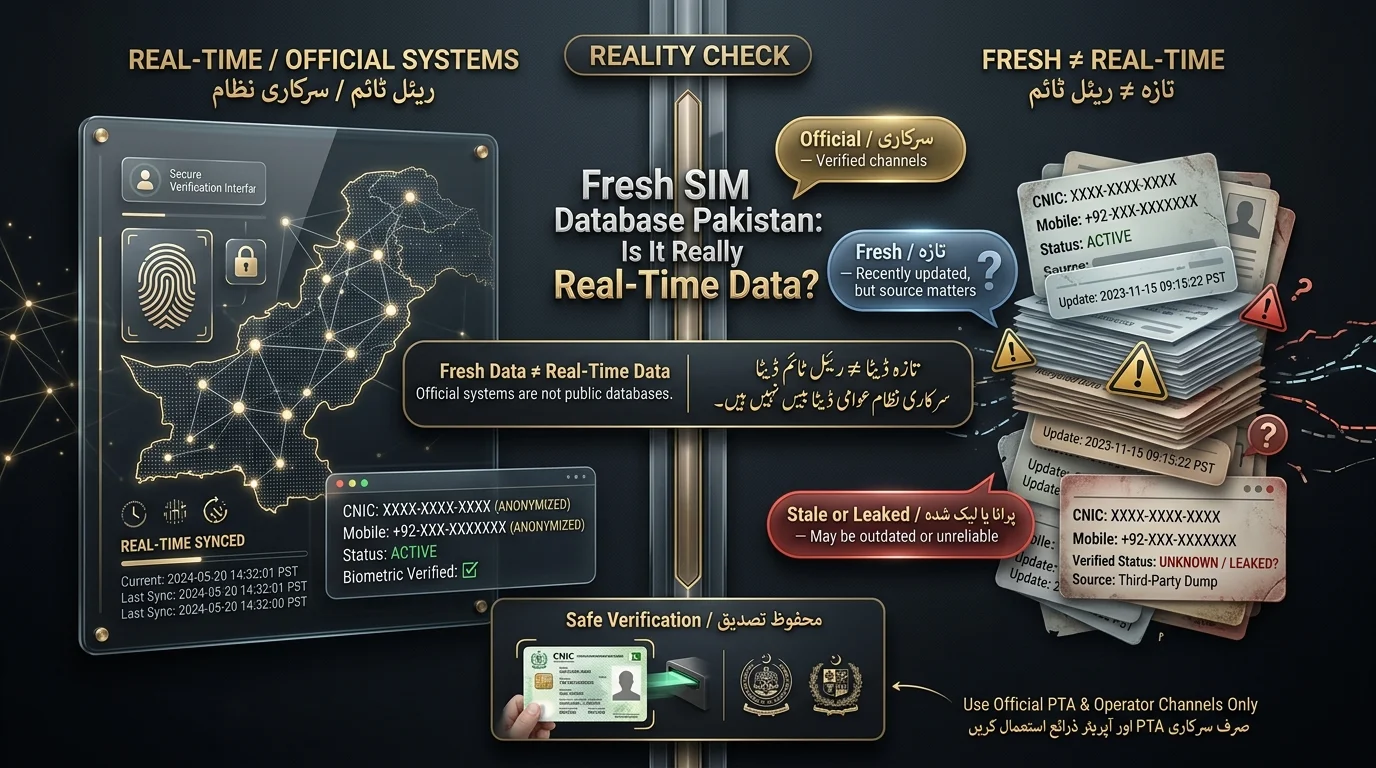
Fresh SIM data refers to current SIM registration activity that is unlikely to be outdated, but there’s no public database containing every Pakistani subscriber’s personal info. Real-time records are maintained in the Pakistan Telecommunication Authority (PTA) and mobile operators’ systems and are not accessible to the public. What is often labeled as a fresh SIM database online is usually outdated or leaked data, not current information.
In summary:
- Fresh data: recently updated, from verified sources
- Stale data: old records
- Leaked data: unauthorized and often outdated
- Real-time systems: exist but are not publicly accessible
To check what’s registered against your CNIC, use official PTA or operator channels only. Other sources are unreliable.
What Is a Fresh SIM Database in Pakistan?
What Does Fresh SIM Data Mean?
When people talk about SIM data, they’re usually referring to some combination of:
- SIM registration records
- Subscriber information tied to a CNIC
- Which mobile network a number belongs to
- Whether a SIM is active or deactivated
- Whether ownership of a number has changed hands
The term fresh indicates the recency of information but does not guarantee the legitimacy, completeness, or authenticity of the source.
Fresh SIM Data vs. SIM Database
The terms fresh data and database are often confused but have different meanings. Fresh data refers to the recency of information, while database refers to the collection of records. An old database can be labeled as fresh, and a current system may not even be a public database. Misunderstanding these terms can lead to misleading claims on websites.
Read Also: Pakistan SIM Database
Why People Search for Fresh SIM Data
Most people land on this topic for a handful of practical reasons:
- They want to check how many SIMs are registered against their own CNIC
- They suspect someone registered a SIM in their name without permission
- They’re trying to confirm which network a number belongs to
- They’re double-checking a registration they recently made
- They’ve stumbled across a SIM database website and want to know if it’s trustworthy
Pakistan offers official, free ways to find answers to various goals, and it’s important to know where to look for these resources.
Real-Time vs. Fresh vs. Stale SIM Data
This is the essential distinction to grasp before trusting anything labeled a SIM database.
| Feature | Real-time/current system | Fresh data | Stale data |
| Recency | Very high | Relatively recent | Old |
| Recent changes | More likely reflected | May be reflected | Often missing |
| New SIM registrations | Potentially reflected | Depends on update cycle | May be absent |
| Deactivated SIMs | More likely updated | May update later | May remain listed as active |
| Ownership changes | Current system may reflect them | Depends on source | Can show old, outdated ownership |
| Source | Authorized system | Identifiable source | Often unknown or leaked |
What Does Real-Time Actually Mean?
In a telecommunications context, real-time refers to an operator’s or regulator’s internal system reflecting changes (like activations or porting events) almost instantly. However, this does not mean that this information is publicly accessible or downloadable. The distinction is important because many SIM database websites wrongfully use the term “real-time” to suggest public access to a system designed for internal use.
What Makes Data Stale?
Data can become outdated for several reasons unrelated to its initial posting date, including:
- Old datasets not refreshed after collection.
- Delayed synchronization between systems.
- Deactivated or reissued numbers.
- Unrecorded ownership or registration changes.
- Subscribers switching networks.
- Ported numbers that change operators.
- Abandoned databases.
Any of these factors can lead to inaccuracies in a dataset over time.
Can Fresh Data Still Be Inaccurate?
The text emphasizes that freshness and accuracy are distinct concepts. A dataset can be recent but still have issues like typos or unreliable information. Recency indicates when data was last updated, but it does not guarantee its correctness.
How SIM Registration Data Is Created and Updated
- SIM Activation Process: When a new SIM is purchased, the operator collects the customer’s CNIC and starts the registration process at the point of sale.
- Biometric Verification: Mandatory fingerprint matching against NADRA’s records is required for SIM activation, preventing unauthorized registrations.
- Operator Records: After verification, the mobile operator keeps the subscriber’s information in their internal systems.
- Regulatory Verification: The PTA oversees SIM registration data but does not make the entire database publicly accessible, maintaining a distinction between oversight and public access.
Why Updates May Not Appear Everywhere at the Same Time
Even within a legitimate ecosystem, information doesn’t always propagate instantly everywhere. Reasons for this include:
- Different systems handling different parts of the process
- Normal processing delays between operator and regulator systems
- Synchronization gaps between databases
- Third-party sites scraping or copying data once and never updating it again
- Cached information that doesn’t reflect the latest state
- Archived datasets that were frozen at a particular point in time
This is exactly why an outside SIM database website, even a well-designed one, is structurally incapable of staying accurate for long.
Official PTA SIM Verification Methods
- PTA SIM Information System: Use the official portal (cnic.sims.pk) to check SIMs registered against your CNIC by operator.
- 668 SIM Information Check: Send your 13-digit CNIC (without dashes) to 668 via SMS to receive a count of SIMs linked to your identity.
- 667 Verification: This shortcode checks details about the SIM currently in your phone, confirming the number and registration status.
- 76367 Network Check: Send an SMS to this number to find out which network operator a given phone number currently belongs to, accounting for mobile number portability.
Important Distinction
None of these official services will hand you:
- Another person’s private CNIC
- Someone’s home address
- Call records
- Live GPS location
- Any other person’s private subscriber information
If a website or service claims to provide something on demand, it’s important to view this as a red flag unless there is solid, authoritative evidence to support the claim.
Fresh SIM Database vs. Leaked SIM Database
Is a Leaked SIM Database the Same as Fresh SIM Data?
No, these are fundamentally different concepts, even if a website markets them using the same language.
What Is a Leaked Database?
A leaked SIM database generally originates from:
- Unauthorized collection of subscriber data
- Historical datasets compiled over time
- Actual data breaches from operators or third parties
- Repackaged older leaks, sometimes reintroduced years later under a new name
Why Leaked Data Becomes Stale
Leaked datasets do not receive updates after someone steals or scrapes them, so the information quickly becomes outdated as circumstances change.
For example:
- A person switches to a different SIM.
- The operator deactivates the original SIM.
- The operator reassigns the number to another subscriber.
- The subscriber updates their information, such as their name, address, or other linked details.
- The people who obtained the leaked database simply stop maintaining it.
A static leaked file cannot reflect any of these changes. It only contains the information available at the time someone stole or scraped the data.
Why Latest Database Claims Are Difficult to Verify
Websites claiming to offer the latest or most updated SIM database face a basic credibility problem:
- There’s no verifiable timestamp proving when the data was actually collected
- The source is usually unknown or deliberately vague
- There’s no audit trail showing where the information came from
- There’s no official verification tying the claim back to PTA or an operator
- Much of what circulates is simply the same recycled dataset, relabeled and reposted
If a site can’t answer where this comes from, and when, there’s no real basis to trust how fresh it is either.
How to Identify Stale or Fake SIM Data
10 Signs a SIM Database Is Stale or Untrustworthy
- No source is provided for where the data came from.
- No update date is given anywhere on the site.
- The site claims 100% accuracy without any way to verify it. But Numpk.com gives a free tool to access the data
- It promises complete CNIC details for anyone, on demand.
- It claims to offer live location tracking.
- It promises access to private call records.
- It asks you to submit unnecessary personal information just to “search.”
- It gives contradictory network information for the same number.
- The same record shows up, word for word, across several unrelated sites.
- It asks you to install an APK or unfamiliar software to unlock results.
What Information Can Actually Be Verified?
| Information | Official Numpk.com | Unofficial verification |
| SIMs associated with your own CNIC | Yes | ❌ |
| Network of a given number | yes(Through 76367 | ❌ |
| Registration information | Limited/authorized channels only | ❌ |
| Someone else’s complete CNIC | Yes | ❌ |
| Someone else’s private address | Yes | ❌ |
| Call history | Yes | ❌ |
| Live location | Yes | ❌ |
Why Old SIM Databases Become Inaccurate
The text highlights how quickly a fresh dataset can become outdated through several examples:
- Deactivated SIM: An old number marked as active when it is actually shut down.
- Reissued Number: A recycled number assigned to a new subscriber, but still linked to the previous owner in the database.
- Ownership Change: Updated registration details not reflected in outdated datasets.
- Network Change: A number ported to a different operator still appearing under the old network.
- Newly Activated SIM: Recent registrations not appearing in older databases.
These examples illustrate that static SIM databases cannot maintain reliability over time.
Fresh SIM Data and Privacy Risks
Privacy Risks of Using SIM Database Websites
Handing over your CNIC or phone number to an unverified SIM database site carries real risk, including:
- Exposure of your CNIC number
- Exposure of your phone number to unknown third parties
- Increased risk of identity theft
- SIM-swap fraud, where someone uses your details to hijack your number
- Phishing attempts built around information you’ve submitted
- Malware, especially if the site pushes you toward downloading an app
- Social engineering attempts using details pulled from these sites
- Unauthorized sharing of your data with parties you never agreed to
Never Upload Sensitive Information to Unknown Sites
A few practical rules worth following:
- Don’t upload photos or scans of your CNIC.
- Don’t install APKs from unfamiliar sources just to unlock a lookup.
- Don’t share OTPs with anyone, for any reason.
- Don’t enter banking credentials on a SIM-lookup site; the two have nothing to do with each other.
- Don’t submit biometric information outside an official, in-person verification process.
- Stick to official verification channels for anything related to your CNIC or SIM registration.
What to Do If You Find an Unknown SIM on Your CNIC
- Verify the SIM information through official channels, like cnic.sims.pk or the 668 SMS service.
- Identify the mobile operator associated with the unknown SIM.
- Contact the operator using official customer-service channels to request an investigation and potential deactivation.
- If unresolved, escalate the issue through PTA’s formal complaint process.
- Keep records of your checks and correspondence for reference.
- Avoid trying to identify the SIM’s owner personally; stick to official channels for resolution.
Final Verdict
Fresh does not automatically mean real-time; they are related but distinct. Real-time official systems differ from public databases; one is hidden while the other often isn’t legitimate. Outdated databases quickly become irrelevant due to constant network changes. Official verification is safer than relying on unknown third-party “SIM databases.” If checking SIMs linked to your CNIC, use official methods like cnic.sims.pk or the 668 SMS service instead of unverified sites. It’s free, faster than it seems, and the only accountable option.
تازہ کا مطلب خود بخود حقیقی وقت نہیں ہے۔ وہ متعلقہ لیکن الگ الگ ہیں. ریئل ٹائم آفیشل سسٹم پبلک ڈیٹا بیس سے مختلف ہوتے ہیں۔ ایک پوشیدہ ہے جبکہ دوسرا اکثر جائز نہیں ہوتا ہے۔ نیٹ ورک کی مسلسل تبدیلیوں کی وجہ سے پرانے ڈیٹا بیس تیزی سے غیر متعلق ہو جاتے ہیں۔ باضابطہ تصدیق نامعلوم فریق ثالث “SIM ڈیٹا بیس” پر انحصار کرنے سے زیادہ محفوظ ہے۔ اگر آپ اپنے CNIC سے منسلک سمز کو چیک کر رہے ہیں تو، غیر تصدیق شدہ سائٹوں کے بجائے cnic.sims.pk یا 668 SMS سروس جیسے سرکاری طریقے استعمال کریں۔ یہ مفت ہے، اس سے کہیں زیادہ تیز، اور واحد جوابدہ آپشن۔
FAQ’s
What is a fresh SIM database in Pakistan?
Current SIM-registration information is stored in PTA and operator systems and is not publicly accessible. It can only be accessed through official verification channels.
Is fresh SIM data real-time?
Operator and PTA systems can update quickly on the back end, but this is not the same as a public database being synchronized in real time. It’s important to consider these two claims separately.
What is stale SIM data?
Outdated information includes active statuses for deactivated numbers, reissued numbers linked to wrong individuals, and inaccurate network details after number porting.
Can I download the latest Pakistan SIM database?
No legitimate, official version of this exists for public download. Anything offered as a downloadable complete SIM database is not an authorized source.
Can I check SIMs registered against my CNIC?
Yes, through PTA’s official portal (cnic.sims.pk) or by sending your CNIC to 668 via SMS. Both are free, official, self-check methods.
Is a leaked SIM database accurate?
Generally no. Leaked datasets are static, unverified, and typically outdated the moment circumstances change for any subscriber in them.
Can a SIM database show someone’s live location?
No official or legitimate service provides this. Any site claiming to offer live GPS tracking from a phone number should not be trusted.
Disclaimer
This article provides general information about SIM-related data in Pakistan, including the differences between fresh, stale, leaked, and real-time data. It explains that regulated systems maintain SIM registration records and that the public cannot access these records as an open database.
For accurate SIM registration information, verify your details through official PTA and mobile operator channels. Avoid websites, services, or individuals that claim to provide unauthorized or private SIM data.
Numpk.com operates independently and has no affiliation with the PTA, mobile operators, or other government authorities. Always check official sources for the latest procedures and requirements, as authorities may update them over time.
The information in this article does not constitute legal or professional advice. Numpk.com does not accept responsibility for losses, issues, or consequences resulting from reliance on unofficial, outdated, or inaccurate information.
Sources & References
- Pakistan Telecommunication Authority (PTA): The key regulator for telecommunications in Pakistan, responsible for SIM registration regulations and consumer information.
- PTA SIM Information System: The official system for checking SIM registrations linked to a CNIC, ensuring accurate and reliable information.
- NADRA (National Database & Registration Authority): The authority responsible for national identity verification and biometric processes necessary for SIM registration.
- Pakistan Telecommunication (Re-organization) Act, 1996: This act establishes the regulatory framework for telecommunications in Pakistan under which the PTA operates.